- • Introduction
- • Tag Heuer Movement Eras: A Quick Overview
- • Heuer Era Movements (Pre-1985)
- • Early TAG Heuer Era Movements (1985–2000s)
- • Modern TAG Heuer Era Movements (2000s–Present)
- • Tag Heuer Movement Identification Guide
- • Common Tag Heuer Movement Issues & Parts
- • Parts Compatibility & Interchangeability
- • Frequently Asked Questions
- • Conclusion
Tag Heuer Movement Guide: Every Caliber from Heuer to TAG Heuer
Tag Heuer has one of the most storied histories in Swiss watchmaking. From the revolutionary Calibre 11 automatic chronograph to the modern in-house Heuer 02, this guide covers every significant Tag Heuer movement — including specifications, common issues, and parts compatibility.
🔧 Restoring a Tag Heuer? We specialize in authentic Tag Heuer parts — movements, crowns, stems, hands, and crystals. Contact us for hard-to-find calibers.
Introduction
Tag Heuer’s movement history is divided into distinct eras. Understanding which era your watch belongs to is the first step in finding the right parts or planning a service.
In this guide, you’ll learn:
- The major eras of Tag Heuer movements (Pre-TAG Heuer, Early TAG Heuer, Modern In-House)
- Complete specifications for every significant caliber
- Common movement issues and failure points
- Parts compatibility and interchangeability
- How to identify your Tag Heuer movement caliber
Tag Heuer Movement Eras: A Quick Overview
| Era | Years | Key Movements | Characteristics |
|---|---|---|---|
| Heuer Era (Pre-1985) | 1860–1985 | Calibre 11, 12, 15, 18 (Chronomatic) | Manual wind, early automatic chronographs, often based on Dubois Dépraz modules |
| Early TAG Heuer Era | 1985–2000s | Calibre 36 (El Primero), 17, 5, 7, 16 | Used Zenith El Primero, ETA, and Sellita base movements |
| Modern TAG Heuer Era | 2000s–Present | Calibre 1887, Heuer 01, Heuer 02, Calibre 5 (Sellita SW200) | In-house manufacturing, modular chronographs, COSC options |
Heuer Era Movements (Pre-1985)
These are the classic “Heuer” movements, used in iconic watches like the Carrera, Monaco, and Autavia. They are prized by collectors and often require specialized knowledge for restoration.
Heuer Calibre 11 / 12 (Chronomatic)
The Calibre 11 was one of the world’s first automatic chronograph movements, developed jointly by Heuer, Breitling, and Hamilton. It used a Dubois Dépraz chronograph module on a Buren base movement. The Calibre 12 was a later evolution.
| Caliber | Base | Type | Beat Rate | Power Reserve | Jewels |
|---|---|---|---|---|---|
| Heuer 11 | Buren 1281 | Auto chronograph | 19,800 bph | 42 hours | 17 |
| Heuer 12 | Buren 1281 | Auto chronograph | 21,600 bph | 42 hours | 17 |
Common Issues: Worn chronograph module components, broken winding pinion, cracked chronograph wheels. Parts are increasingly difficult to find.
Heuer Calibre 15 / 18
These were manual-wind chronograph movements used in the 1970s. The Calibre 15 was a manual-wind version of the Chronomatic concept, while the Calibre 18 was a thinner manual chronograph.
| Caliber | Type | Beat Rate | Power Reserve |
|---|---|---|---|
| Heuer 15 | Manual chronograph | 21,600 bph | 48 hours |
| Heuer 18 | Manual chronograph (thin) | 21,600 bph | 44 hours |
Early TAG Heuer Era Movements (1985–2000s)
After the TAG acquisition, Heuer began using third-party movements from Zenith, ETA, and later Sellita. This era produced some of the most collectible modern Heuer watches, including the Carrera re-editions.
Calibre 36 (Zenith El Primero)
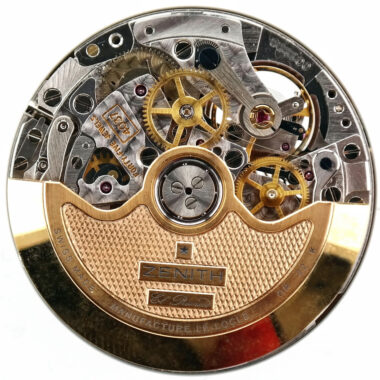
The Calibre 36 is one of the most respected movements in TAG Heuer’s history. It is a modified Zenith El Primero, one of the first automatic chronograph movements. It was used in the Carrera “Tachymetre” and other limited editions.
| Specification | Detail |
|---|---|
| Type | Automatic chronograph (integrated) |
| Beat Rate | 36,000 bph (5Hz) — high frequency |
| Power Reserve | 50 hours |
| Jewels | 31 |
| Hand Sizes (h/m/s) | 90 / 150 / 25 |
| Stem Tap | 1.2mm |
Notes: The Calibre 36 is highly sought after. The high-beat movement offers a smooth sweep but requires specialized service. Parts are available but can be expensive.
Calibre 17 (ETA 2894-2)
The Calibre 17 is a modular automatic chronograph based on the ETA 2892-2 with a Dubois Dépraz chronograph module. It was used in the Aquaracer and Carrera chronographs.
| Specification | Detail |
|---|---|
| Base | ETA 2892-2 |
| Chronograph Module | Dubois Dépraz 2030 |
| Beat Rate | 28,800 bph (4Hz) |
| Power Reserve | 42 hours |
| Hand Sizes (h/m/s) | 90 / 150 / 25 |
Common Issues: Worn chronograph module (pivots, wheels), lubricant degradation. The module can be serviced separately from the base movement.
Calibre 16 (Valjoux 7750)
The Calibre 16 is a robust automatic chronograph based on the legendary Valjoux 7750 (now ETA 7750). It is widely used in the Carrera, Aquaracer, and Formula 1 chronographs.
| Specification | Detail |
|---|---|
| Base | ETA 7750 (Valjoux 7750) |
| Beat Rate | 28,800 bph (4Hz) |
| Power Reserve | 46 hours |
| Hand Sizes (h/m/s) | 90 / 150 / 25 |
| Stem Tap | 1.2mm |
Notes: The Valjoux 7750 is a workhorse movement. It is reliable, easy to service, and parts are widely available. It has a distinctive cam-operated chronograph mechanism.
Calibre 5 (ETA 2824-2 / Sellita SW200)
The Calibre 5 is TAG Heuer’s entry-level automatic movement, used in three-hand models like the Carrera, Aquaracer, and Formula 1. Originally based on the ETA 2824-2, later production uses the Sellita SW200-1.
| Specification | Detail |
|---|---|
| Base (Early) | ETA 2824-2 |
| Base (Modern) | Sellita SW200-1 |
| Beat Rate | 28,800 bph (4Hz) |
| Power Reserve | 38 hours |
| Hand Sizes (h/m/s) | 90 / 150 / 25 |
| Stem Tap | 1.2mm |
Common Issues: Manual winding issues (ETA 2824-2 known for reverser wheel wear), date jumper spring failure.
Modern TAG Heuer Era Movements (2000s–Present)
In recent years, TAG Heuer has invested heavily in in-house manufacturing. The Heuer 01 and Heuer 02 represent a new generation of integrated chronograph movements.
Calibre 1887 / Heuer 01
The Calibre 1887 was TAG Heuer’s first modern in-house automatic chronograph. It was later evolved into the Heuer 01, a skeletonized version used in the Carrera Heuer 01. The movement is integrated (not modular) and offers a column wheel for precise chronograph operation.
| Specification | Detail |
|---|---|
| Type | Automatic chronograph (integrated, column wheel) |
| Beat Rate | 28,800 bph (4Hz) |
| Power Reserve | 50 hours |
| Jewels | 39 |
| Hand Sizes (h/m/s) | 90 / 150 / 25 |
Heuer 02 (TH20-00)
The Heuer 02 is the successor to the Heuer 01. It offers an 80-hour power reserve and a more refined construction. It is currently used in the Carrera, Monaco, and Autavia lines. The caliber is also known as the TH20-00 in newer models.
| Specification | Detail |
|---|---|
| Type | Automatic chronograph (integrated, column wheel) |
| Beat Rate | 28,800 bph (4Hz) |
| Power Reserve | 80 hours |
| Jewels | 33 |
| Hand Sizes (h/m/s) | 90 / 150 / 25 |
Calibre 7 (ETA 2893-2) & Calibre 8
These are GMT and dual-time movements used in the Carrera and Aquaracer lines.
- Calibre 7: GMT movement based on ETA 2893-2. Hand sizes: 90/150/25. Stem tap: 1.2mm.
- Calibre 8: Dual-time (non-GMT) movement, also based on ETA 2892-2 with added module.
Quartz Movements (Calibre 1, 2, 3, 9)
TAG Heuer has used various quartz movements over the years, primarily in the Formula 1, Aquaracer, and Link lines. Most are based on Ronda, ETA, or Miyota movements with TAG Heuer branding.
- Calibre 1 (Ronda 715 / 705): Chronograph quartz.
- Calibre 2 (Ronda 5040.D): 3-hand with date.
- Calibre 3 (Ronda 5040.D): Similar to Calibre 2, used in women’s watches.
- Calibre 9 (Ronda 6004.D): GMT quartz.
Tag Heuer Movement Identification Guide
To identify your Tag Heuer movement, you can use the following methods:
1. Check the Case Back
Many Tag Heuer watches have the caliber number engraved on the case back. Look for “Calibre X” or “Cal X” near the model number.
2. Remove the Case Back
If the caliber is not visible, you’ll need to open the watch. Use a proper case opener to avoid damage.
3. Locate the Caliber Markings
- ETA/Sellita-based movements: Look for “ETA”, “SW”, or TAG Heuer markings on the rotor or mainplate.
- Heuer 01/02: Clearly marked on the rotor or visible through the case back.
- Zenith-based (Calibre 36): Marked with “Zenith” or “Calibre 36” on the rotor.
Common Tag Heuer Movement Issues & Parts
| Movement | Common Issue | Typical Replacement Part |
|---|---|---|
| Calibre 5 (2824-2) | Manual winding failure | Reverser wheels (ETA 2824-2 specific) |
| Calibre 16 (7750) | Worn chronograph hammer, broken chronograph wheel | 7750 chronograph parts |
| Calibre 17 (2894-2) | Chronograph module failure | Dubois Dépraz 2030 module parts |
| Heuer 01 / 02 | Rotor bearing noise, low amplitude | Complete service, specific in-house parts |
| Heuer 11 / 12 | Chronograph module wear | Dubois Dépraz module parts (hard to find) |
Parts Compatibility & Interchangeability
- ETA 2824-2 / Sellita SW200-1: Fully interchangeable. Hand sizes, stem taps, and dimensions are identical. A Calibre 5 based on one can be replaced with the other.
- Valjoux 7750 (Calibre 16): Standardized movement. All parts are widely available from ETA and third-party suppliers.
- ETA 2892-2 (base for Calibre 17 and Calibre 36 in some models): Widely available. Chronograph modules are specific to the caliber.
- Heuer 01 / 02: In-house movements. Parts are only available through TAG Heuer or specialized suppliers. We stock a selection of these parts.
Shop ETA and Sellita movements →
Frequently Asked Questions
What is the most reliable Tag Heuer movement?
The Calibre 16 (Valjoux 7750) is widely considered the most reliable. It’s a robust, time-tested design with excellent parts availability. The Calibre 5 (ETA 2824-2/SW200) is also very reliable for three-hand models.
Can I replace my Calibre 5 with a Sellita SW200?
Yes, if your watch uses the ETA 2824-2 version, the Sellita SW200-1 is a direct, drop-in replacement. Hand sizes, stem height, and dimensions are identical.
Are Tag Heuer in-house movements worth the extra cost?
For collectors and enthusiasts, yes. The Heuer 02 offers an 80-hour power reserve and a column-wheel chronograph. For the average user, the Calibre 16 offers excellent performance at a lower service cost.
How do I know if my Tag Heuer has a genuine ETA or Sellita movement?
Remove the case back. Genuine movements will have markings such as “ETA”, “SW”, or “TAG Heuer” with the caliber number. Be cautious of replicas, which often use unmarked or poorly finished Chinese movements.
Where can I find parts for vintage Heuer movements?
Vintage Heuer parts (Calibre 11, 12, 15, 18) are increasingly rare. We carry a selection of vintage Heuer parts and can source specific components. Contact us with your needs.
What is the service interval for a Tag Heuer movement?
TAG Heuer recommends service every 3-5 years. For the Calibre 16 (7750) and Calibre 5 (2824/SW200), a service interval of 5-7 years is common with regular wear.
Conclusion
Tag Heuer’s movement history is diverse, spanning vintage Heuer chronographs, modern in-house calibers, and reliable ETA-based movements. Understanding which movement your watch uses is the key to successful repairs, upgrades, and parts sourcing.
Key takeaways:
- Identify your caliber — check the case back or open the watch
- Know the base movement — ETA, Sellita, Zenith, or in-house
- Match hand sizes and stem taps — critical for parts replacement